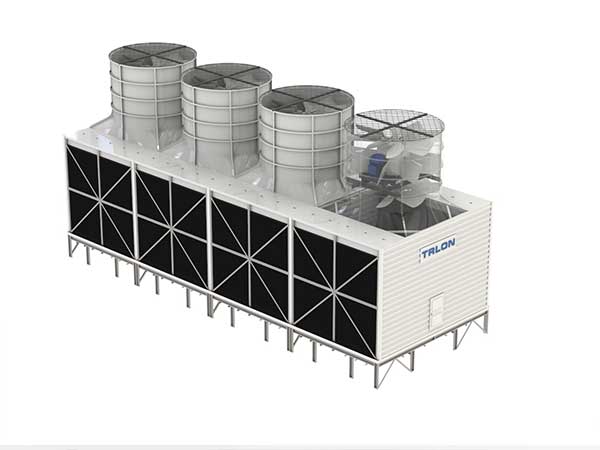
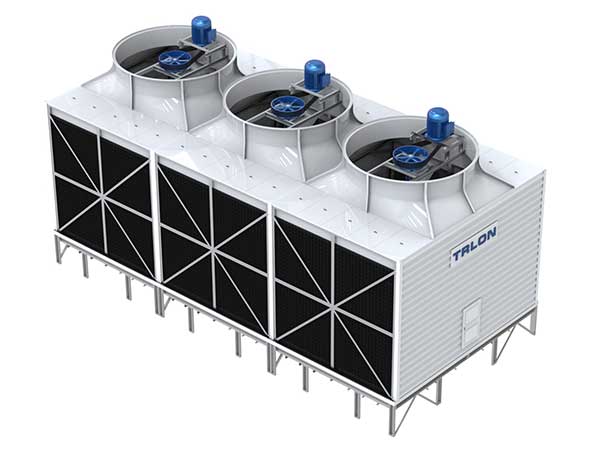
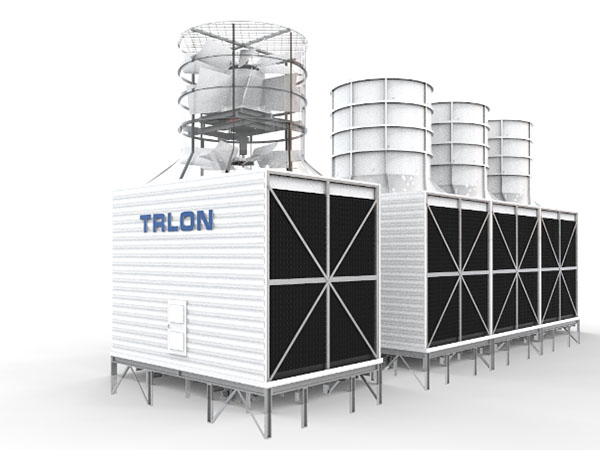
Trlon air conditioner manufacturers have silent cooling towers, closed cooling towers and cooling tower noise reduction, maintenance and transformation services.

 National Service Hotline:
4008-8383-95
National Service Hotline:
4008-8383-95
What are the factors that affect the cooling effect of closed cooling towers?
To understand the factors that affect the cooling effect of a closed cooling tower, it is necessary to first understand the cooling principle of the tower. By utilizing the temperature difference between water and air, heat is dissipated through the contact between warm water and cold air, as well as through the evaporation of water itself. The influence of water quality on the amount of dirt attached to the heat transfer tube and the problem of circulating water volume. If the circulating flow rate is too small, the heat transfer efficiency will decrease; Excessive circulating flow increases energy consumption.
What are the factors that affect the cooling effect of closed cooling towers?
1、 The impact of water quality
1. The temperature of water
2. The sediment content of water
3. Calcium ion content in water
4. Concentration of dissolved oxygen in water (O2 content)
5. The temperature difference between water temperature and air
6. PH value in water
7. Turbidity of water
8. The influence of suspended solids in water on fluidization
9. The influence of water quality on the adhesion of dirt inside heat transfer tubes
2、 The problem of circulating water volume is that the circulating flow rate is too small, which reduces the heat transfer efficiency; Excessive circulating flow increases energy consumption.
3、 Problems with the filling layer and water spraying device
1. Unreasonable arrangement of sprinkler pipeline
2. Unreasonable nozzle design
3. The diameter of the water pipe is too small
4. The water distribution pipeline is too long or has too many twists and turns
4、 Aerodynamic factors
5、 Other factors: such as the length and direction of piping.
1、 Cooling principle of cooling tower
By utilizing the temperature difference between water and air, heat is dissipated through the contact between warm water and cold air, as well as through the evaporation of water itself.
2、 Concepts related to cooling towers.
To illustrate the cooling temperature of the cooling tower, the following related concepts need to be introduced first.
1. Air temperature: divided into dry bulb temperature and wet bulb temperature.
1) Dry bulb temperature: It is the true temperature of the air and can be directly measured using a regular thermometer.
2) Wet bulb temperature: The air temperature at which water vapor in the air reaches saturation under the same enthalpy state. On the air enthalpy humidity chart, it decreases from the air state point along the isentropic line to the 100% relative humidity line, corresponding to the dry bulb temperature at that point. Simply put, it is the lowest temperature that can be achieved in the current environment solely through evaporation of water. The wet bulb temperature varies in different regions, and the average wet bulb temperature standard in China is 28 ℃. Usually represented by the letter "t_w2".
2. Cooling amplitude: It is equal to the temperature difference between the cooling water entering and leaving the tower, indicating the cooling amplitude of the cooling water after passing through the cooling tower, usually represented by the letter "? T". Standards? T=t1-t2=5 ℃, where t1 and t2 are the inlet and outlet temperatures of the cooling tower, respectively.
3. Approximation degree: It is equal to the temperature difference between the outlet water temperature of the cooling tower and the wet bulb temperature of the air, indicating the degree to which the outlet water temperature approaches the wet bulb temperature, represented by the letter "A". The standard approximation degree A is 4 ℃.
4. In summary, assuming that the wet bulb temperature in a certain area is 28 ℃, the standard outlet temperature of the cooling tower in that area is t2=t_v2+A=28 ℃+4 ℃=32 ℃, and the standard inlet temperature is t1=t2+? t=32℃+5℃=37℃
Article Address:https://www.trlen.com/baike/761.html
Guangdong Trlon Energy-saving Air Conditioning Equipment Co., Ltd.
Contact:Mr. Wang
Free Hotline:4008-8383-95
Company Email:sales@trlon.com
Web Site:https://www.trlen.com/
Company Address: 1916A, Block A, David Donglong Business Building, Longhua, Longhua District, Shenzhen