Trlon air conditioner manufacturers have silent cooling towers, closed cooling towers and cooling tower noise reduction, maintenance and transformation services.

 National Service Hotline:
4008-8383-95
National Service Hotline:
4008-8383-95
The Water Supply Principle of Closed Cooling Tower
Closed cooling towers are highly efficient heat exchange devices that are widely used in situations where strict water quality control and pollution prevention are required. It has its own unique water supply principle. Here is a detailed explanation of the working process of a closed cooling tower. Let's take a look together!
1. Basic structure of closed cooling tower
A closed cooling tower mainly consists of the following parts:
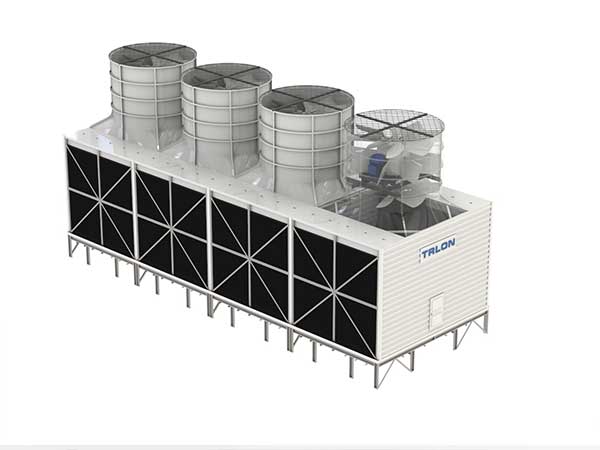
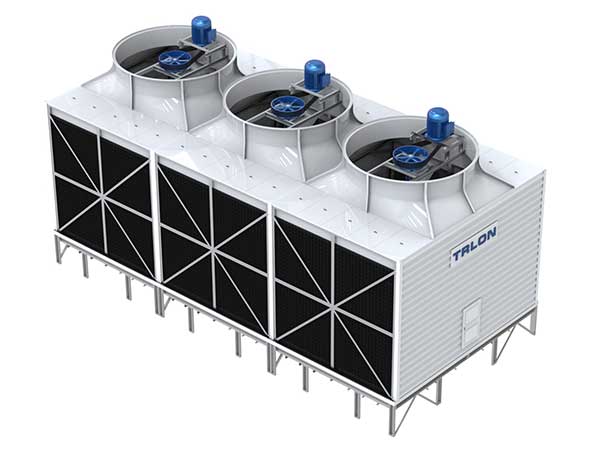
Closed coil (heat exchanger): The cooling medium (usually water or ethylene glycol solution) circulates inside the coil without direct contact with the outside air.
Spray water system: Spray water flows outside the coil to cool the medium inside the coil.
Fan: Forces air flow to enhance evaporative cooling effect.
Water tank: stores spray water and circulates it through a water pump.
Packing (optional): Some closed cooling towers use packing in the spray water system to increase the contact area between water and air and improve cooling efficiency.
2. Water supply principle
The water supply for a closed cooling tower is divided into two parts:
Closed loop water system:
The cooling medium (such as hot water) circulates inside the closed coil without coming into contact with the outside air.
The cooling medium transfers heat to the outer wall of the coil through the coil.
The cooled medium returns to the equipment or process system to complete the cycle.
Spray water system:
Spray water is extracted from the water tank through a water pump and sprayed onto the outer surface of the closed coil.
Spray water forms a water film on the outer wall of the coil, which comes into contact with air and carries away the heat inside the coil through evaporative cooling and sensible heat exchange.
After the spray water absorbs heat, some of it evaporates, and the remaining water flows back to the water tank for recycling.
3. Working process
The working process of a closed cooling tower can be divided into the following steps:
Heat transfer:
High temperature cooling medium (such as hot water) enters the closed coil and transfers heat to the outer wall of the coil.
The heat on the outer wall of the coil is transferred to the spray water through conduction.
Spray water cooling:
Spray water onto the outer surface of the coil to form a water film.
The air is forced to flow through the fan and comes into contact with the spray water, undergoing evaporative cooling and sensible heat exchange.
Evaporative cooling takes away most of the heat, while sensible heat exchange transfers heat through the temperature difference between air and water.
Heat dissipation:
After the spray water absorbs heat, some of it evaporates into the air, and the remaining water flows back to the water tank.
The evaporated water is discharged from the cooling tower through a fan, and the heat is then dissipated into the atmosphere.
Recycling:
After being filtered and replenished in the water tank, the spray water is circulated again through the water pump.
The cooled medium returns to the equipment or process system from the outlet of the coil, completing the cycle.
4. Characteristics of water supply system
Closed loop water system:
The cooling medium circulates in a closed coil without contact with the outside, avoiding pollution and scaling problems.
Suitable for occasions with high water quality requirements, such as precision equipment cooling, process cooling, etc.
Spray water system:
Spray water comes into contact with air and carries away heat through evaporative cooling and sensible heat exchange.
Spray water can be recycled to reduce water resource consumption.
In general, the water supply principle of a closed cooling tower is based on the collaborative work of a closed circulating water system and a sprinkler water system. The closed-loop water system ensures that the cooling medium is not contaminated, while the spray water system efficiently dissipates heat through evaporative cooling and sensible heat exchange. This design gives closed cooling towers significant advantages in energy conservation, environmental protection, and water quality control, making them suitable for various industrial and high-precision cooling applications.
Article Address:https://www.trlen.com/news/752.html
Guangdong Trlon Energy-saving Air Conditioning Equipment Co., Ltd.
Contact:Mr. Wang
Free Hotline:4008-8383-95
Company Email:sales@trlon.com
Web Site:https://www.trlen.com/
Company Address: 1916A, Block A, David Donglong Business Building, Longhua, Longhua District, Shenzhen